Appendix F - A 6-12 Month In-Depth Self-Study Roadmap#
Try it | Section 0.3 in the intro is the 12-week “get started” compressed route; this section is the 6-12 month “understand and produce results” deep route. It is for people who want to truly absorb digital image processing, information hiding, and machine learning, and do research/engineering. Both routes use the same content; only the time allocation differs.
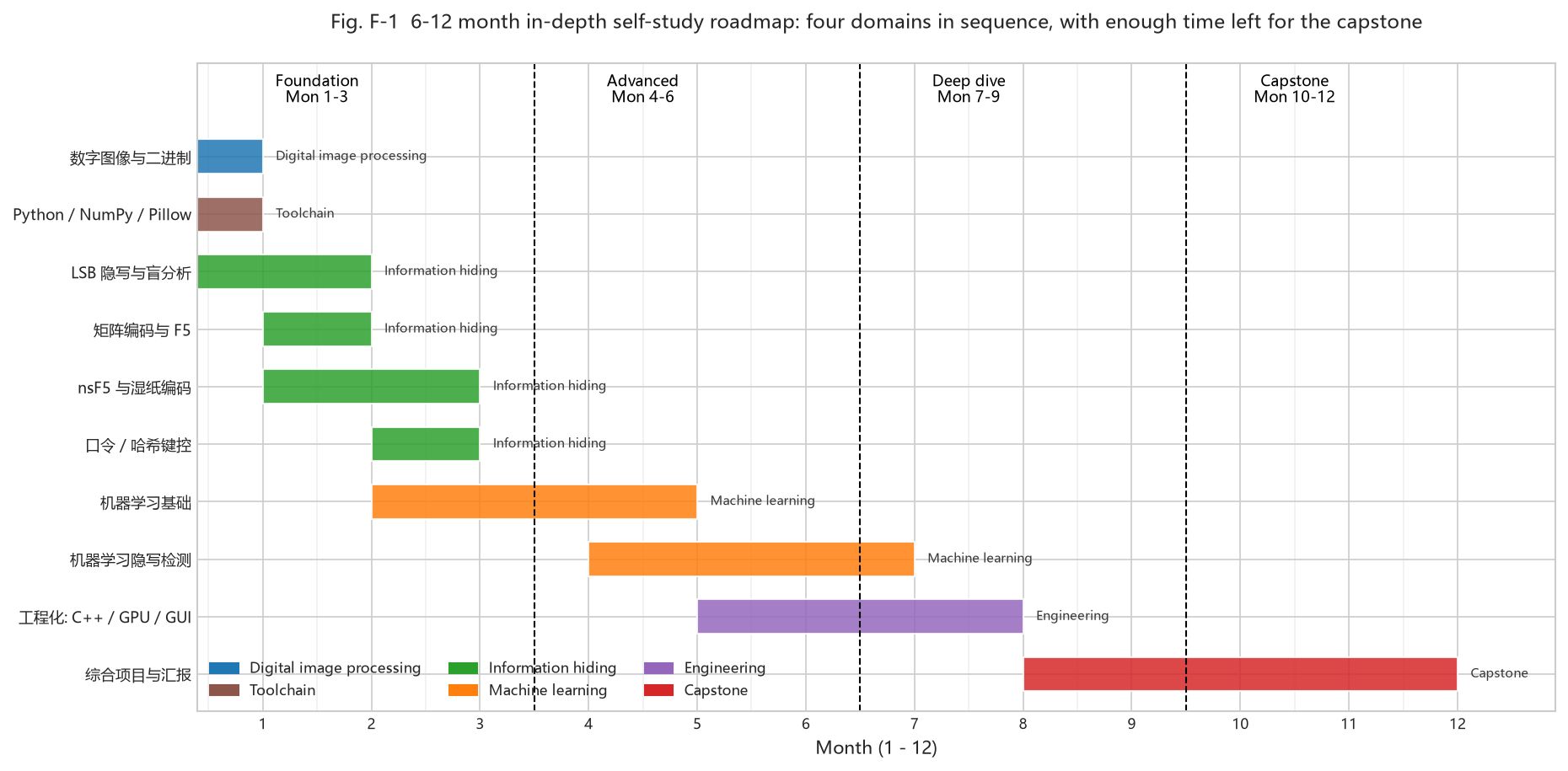
Fig. F-1 (6-12 month Gantt: x-axis = month, y-axis = topic, color = field; dashed lines split it into Foundation (1-3) / Intermediate (4-6) / Advanced (7-9) / Project (10-12))
F.1 Four Phases: Goals and Deliverables of Each#
Phase |
Months |
Goal |
Main content |
What you can do at the end |
|---|---|---|---|---|
Foundation |
1-3 |
Solidify the “groundwork” of all three fields |
ch01 digital images & binary, ch02 Python toolchain, ch03 LSB hiding & blind analysis, ch04 matrix embedding & F5, ch05 nsF5 wet paper, ch06 hash keying |
Independently “hide a sentence -> catch it with chi-square/RS”; hand-compute a p=3 Hamming embedding; explain wet-paper decoding |
Intermediate |
4-6 |
Enter machine learning; build the “features->model->evaluation” frame |
ch07 ML foundations, ch08 ML steganalysis (11-D -> 143-D -> dual models) |
Explain overfitting/data leakage/GroupKFold/AUC; read and reproduce the v1 11-D training pipeline |
Advanced |
7-9 |
Absorb the engineering and the “why designed this way” |
ch08.8 SRM and 143d/53d strategy, ch09 engineering (C++ / GPU / GUI / multi-source data) |
Read SRM filtering and 143-D features; understand same-source vs cross-source differences; run GPU batch features and self-checks |
Project |
10-12 |
Do one complete work of “your own” |
ch10 capstone, ch11 report; plus one research or engineering track |
Complete a reproducible improvement experiment with an honest result analysis; present without notes |
Tip | “Foundation” is almost identical to the 12-week route, just spending more time thinking through every why (especially Chapter 3’s statistical detection and Chapter 5’s wet paper). The real difference is in “Advanced” and “Project”.
F.2 Four Tracks: Taking “Broad, Complete, Practical” through#
To produce results, do not spread evenly. Go deep on one track; keep the rest at “understands it” level:
Track |
Focus |
Deep-dive references |
|---|---|---|
Algorithm |
nsF5/F5, matrix embedding, wet paper, syndrome |
ch04-05, project |
Detection / ML |
feature engineering, SRM, 143d/53d, OOD |
ch08, |
Engineering |
C++ DLL, GPU batch, GUI, multi-source datasets, CI |
ch09, |
Research |
reproduce papers -> find a gap -> improve -> honest evaluation |
literature (appE) and |
F.3 Optional “Go Further” Topics (pick 1-2 by track)#
JPEG-domain hiding: move ch04-05 to quantized DCT coefficients (the companion project yccstego is this direction); feel “spatial vs transform domain” difference;
Deep steganalysis: under small-sample constraints, use explainable features first to verify the signal, then cautiously introduce deep models (the ch08.1 lesson);
Domain adaptation / cross-source robustness: In the v1-era protocol SRM gains on same-source but loses on cross-source (ch08.8.1; not reproduced in the current revision); study how adaptation makes features stable across cameras/compression;
Adversarial robustness and false-positive control: study “loose vs strict” thresholds and Youden / low-FP trade-offs (ch07), and the physical ceiling of undetectable embedding;
Explainability: 143d robust vs 53d interpretable (ch08.8.4); study which features truly contribute the gain and how to explain per-dimension.
Back to the code | Land any of the above on code: first reproduce the baseline, then make a small change, and use
GroupKFoldfor an honest comparison. “Changed A, result got better” is not enough; prove it truly got better using the train/calibration/test three-layer structure + grouped split. (ch07, ch08 stress this repeatedly.)
F.4 Relation to the 12-Week Route (0.3)#
Want to get started quickly: follow 0.3; in 12 weeks, tick off Appendix C;
Want to go deep and produce results: follow this section; over 6-12 months, slow down, deepen, and connect the 0.3 weekly tasks, and add the parts of the 0.5 project map that are only truly needed for research (SRM, multi-source, GPU, dual models, OOD validation) in the “Advanced/Project” phases.
Common bottom line for both: never skip the “hands-on experiments”, and never skip “honest evaluation”. The most important thing this handbook wants to teach is not a single algorithm but “how to tell whether an experimental conclusion is trustworthy”.
Think about it | Which track do you plan to take? How long is your cycle? (12 weeks vs 6-12 months means you spend time on “width” or “depth”.) Write it down as your personal goal for this book.